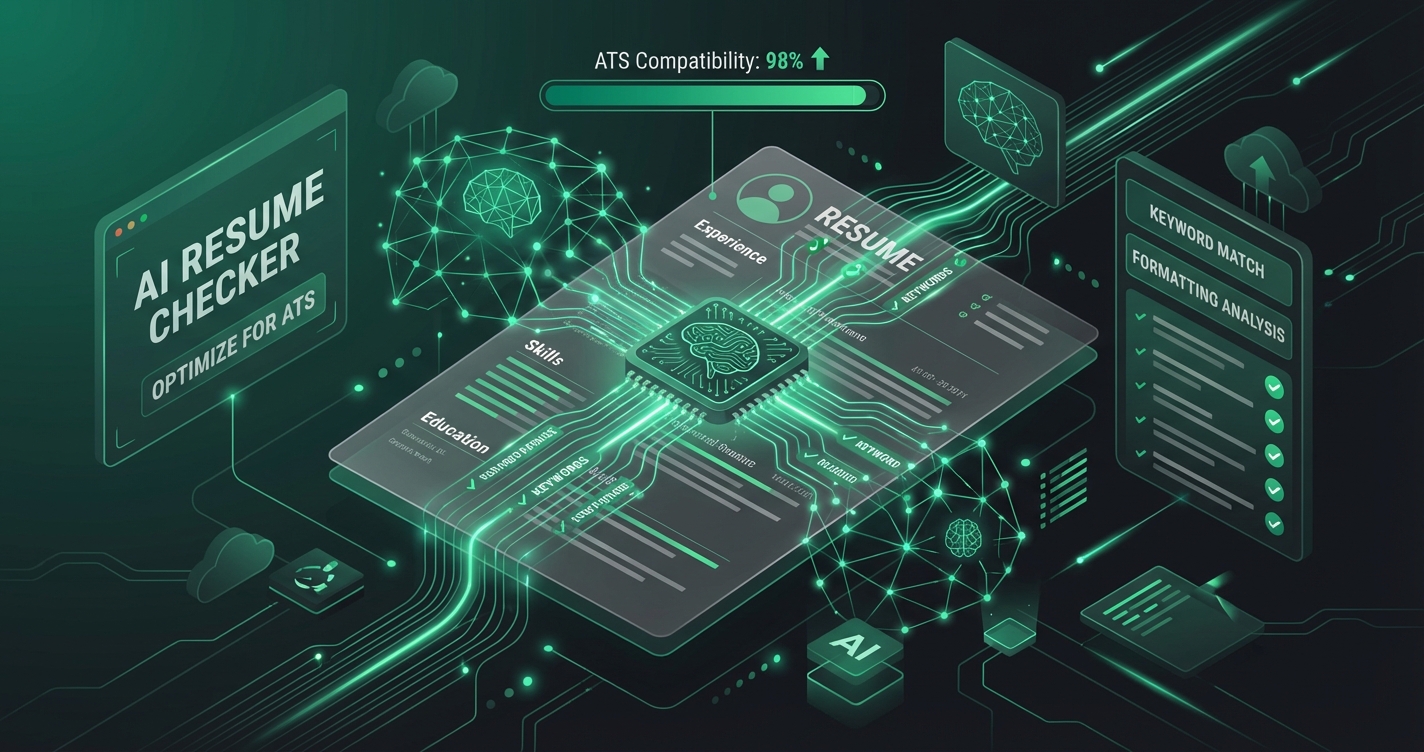
ATS Resume Checker: Your Complete Guide to Beating Applicant Tracking Systems in 2026
Discover how an ATS resume checker can help you optimize your resume for applicant tracking systems. Learn expert strategies to pass ATS scans and land interviews.
Introduction
Picture this: You've spent hours crafting the perfect resume, tailoring your experience to match a dream job posting, and hitting submit with confidence. Yet weeks pass without a single response. The frustrating reality? Your resume likely never reached human eyes. According to recent industry research, over 75% of resumes are rejected by Applicant Tracking Systems (ATS) before a recruiter ever sees them. In today's competitive job market, where companies receive hundreds of applications for a single position, understanding and optimizing for ATS has become non-negotiable.
This is where an ATS resume checker becomes your secret weapon. These specialized tools analyze your resume through the same lens as corporate recruiting software, identifying potential red flags that could disqualify you before the interview stage. Whether you're a recent graduate entering the workforce or a seasoned professional looking for your next opportunity, mastering ATS optimization can dramatically increase your chances of landing interviews.
In this comprehensive guide, we'll explore everything you need to know about ATS resume checkers: how they work, why they're essential for modern job seekers, how to choose the right tool, and actionable strategies to ensure your resume passes ATS scans with flying colors. By the end, you'll have a clear roadmap to transform your resume from ATS-invisible to interview-worthy.
Understanding Applicant Tracking Systems and Why You Need an ATS Resume Checker
What Is an Applicant Tracking System?
Applicant Tracking Systems are sophisticated software platforms that companies use to manage their recruitment process. Think of them as digital gatekeepers that filter, organize, and rank job applications before human recruiters get involved. Initially designed to streamline hiring for large corporations, ATS technology has now become ubiquitous—over 99% of Fortune 500 companies and approximately 66% of large companies use some form of ATS, with adoption rapidly growing among small and medium-sized businesses.
These systems do more than simply collect resumes. They parse your document, extracting key information like contact details, work history, education, and skills. Then they compare this data against job requirements, assign compatibility scores, and rank candidates accordingly. Resumes that don't meet certain thresholds never make it to the recruiter's desk, regardless of how qualified the candidate might actually be.
How ATS Systems Screen Resumes
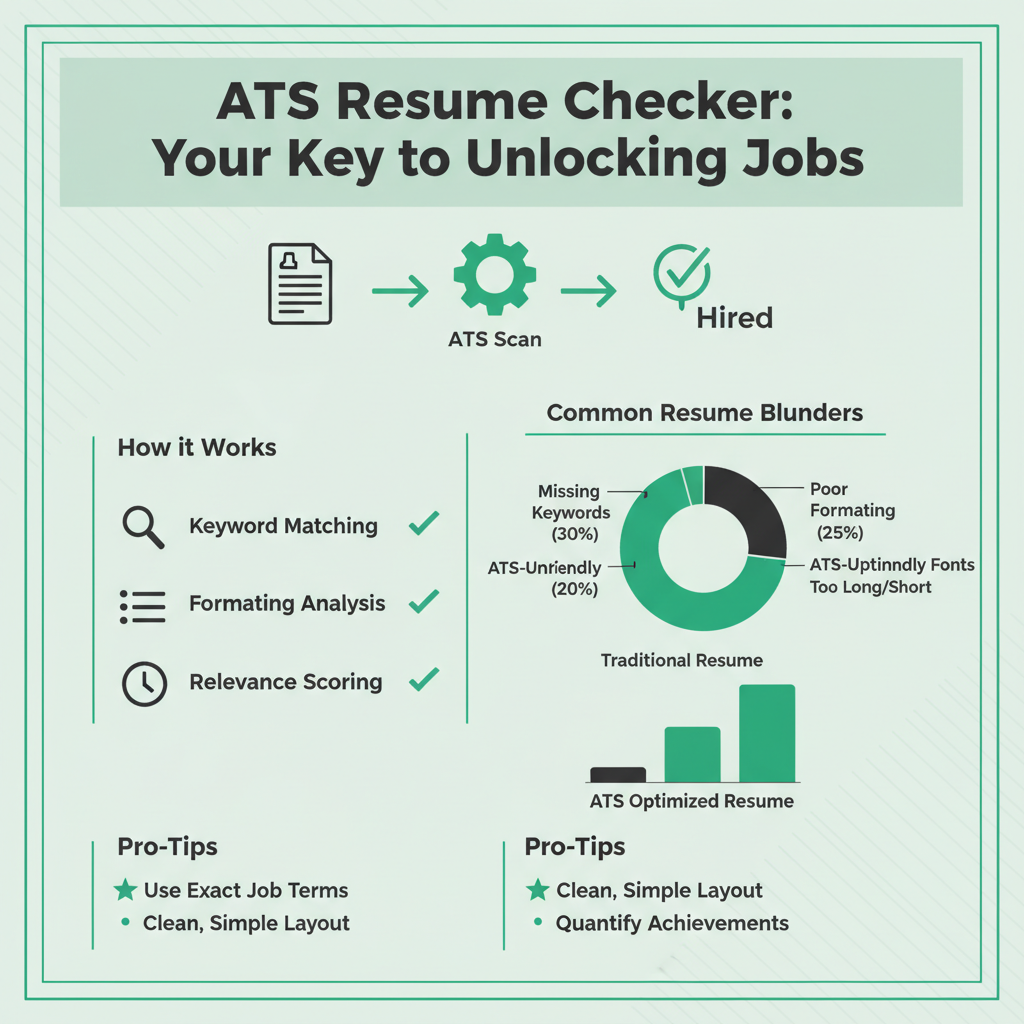
The screening process happens in multiple stages. First, the ATS attempts to parse your resume—converting the formatted document into structured data it can analyze. This is where many resumes fail; complex formatting, tables, graphics, and unusual fonts can confuse the parsing algorithm, causing critical information to be misread or overlooked entirely.
Next, the system scans for specific keywords and phrases related to the job posting. If you're applying for a "Senior Marketing Manager" position requiring "SEO expertise" and "campaign management," the ATS will search for those exact terms and related variations. Missing key terminology—even if you have the actual experience—can tank your ranking.
Finally, modern ATS platforms employ increasingly sophisticated algorithms, some incorporating AI-powered resume analysis to evaluate factors like career progression, employment gaps, education credentials, and overall fit. They may filter out resumes with frequent job changes, unexplained gaps, or qualifications that don't meet minimum requirements.
The Critical Role of an ATS Resume Checker
This is precisely why using an ATS resume checker before submitting applications is crucial. These resume optimization tools reverse-engineer the ATS process, showing you exactly what the system "sees" when it scans your resume. A quality ATS checker will:
- Parse your resume the same way an ATS would, revealing formatting issues
- Identify missing keywords from the job description
- Analyze content structure for ATS compatibility
- Provide a match score indicating your likelihood of passing ATS filters
- Offer specific recommendations for improvement
Research shows that job seekers who use an ATS resume checker and implement its recommendations are 60% more likely to receive interview requests compared to those who don't optimize their resumes. The investment of 15-30 minutes running your resume through a checker can mean the difference between your application landing in the "interview" pile or the digital trash bin.
Key Features to Look for in the Best ATS Resume Checker
Comprehensive Keyword Analysis and Optimization
The cornerstone of any effective ATS resume checker is robust keyword analysis. The best tools don't just identify missing keywords—they provide context-aware suggestions that help you naturally integrate relevant terms without resorting to keyword stuffing, which both ATS algorithms and human readers can detect.
Look for checkers that offer:
- Side-by-side comparison of your resume against the job description
- Keyword density metrics showing whether you've used terms appropriately
- Semantic keyword suggestions that include synonyms and related phrases
- Industry-specific terminology recommendations based on your field
- Skills gap analysis highlighting qualifications you should emphasize or acquire
Premium ATS optimization tools use natural language processing to understand context, ensuring that "managed teams" and "team leadership" are recognized as related concepts. This sophisticated approach mirrors how modern ATS platforms evaluate applications.
Format and Parsing Compatibility Testing
One of the most common reasons resumes fail ATS screening has nothing to do with qualifications—it's formatting issues that prevent proper parsing. An exceptional resume optimization tool will test your document against multiple ATS platforms, as different systems handle formatting differently.
Essential formatting checks include:
- File type compatibility (testing both .docx and PDF formats)
- Font readability assessment
- Section header recognition (ensuring "Work Experience" is properly identified)
- Date format parsing (verifying employment dates are correctly extracted)
- Contact information extraction accuracy
- Table and column detection (flagging problematic layouts)
The tool should show you a "parsed version" of your resume—essentially what the ATS sees after processing your document. This view is often eye-opening, revealing that your carefully formatted three-column layout appears as jumbled text to the system.
Match Score and Actionable Feedback
Numbers provide clarity. The best ATS resume checker tools assign a quantitative match score—typically a percentage indicating how well your resume aligns with the target job posting. However, a score alone isn't enough; you need specific, actionable guidance on improvement.
Quality ATS checkers provide:
- Overall match percentage with clear scoring methodology
- Category-specific scores (keywords, format, skills, experience)
- Prioritized recommendations ranked by impact
- Before-and-after comparison capabilities
- Industry benchmarking showing how your score compares to successful applicants
For example, rather than simply stating "add more keywords," an effective tool might specify: "Include 'project management' 2-3 more times, add 'Agile methodology' to your skills section, and incorporate 'stakeholder communication' in your work experience descriptions."
AI-Powered Resume Insights
As ATS technology evolves to incorporate artificial intelligence, the most advanced AI-powered resume checkers now include machine learning capabilities that go beyond basic keyword matching. These intelligent systems can:
- Predict hiring manager preferences based on successful candidate profiles
- Identify redundant or weak content that dilutes your message
- Suggest power verbs and impact statements to strengthen descriptions
- Analyze tone and language for professional appropriacy
- Detect potential bias triggers that might unconsciously affect readers
- Compare your resume against industry-specific best practices
Some cutting-edge platforms even simulate the complete hiring workflow, showing where your resume would rank among other applicants and providing competitive intelligence about what makes top candidates stand out.
How to Use an ATS Resume Checker: Step-by-Step Strategy
Step 1: Prepare Your Materials
Before running your resume through an ATS resume checker, gather everything you'll need for a thorough analysis. Start with your current resume in a common format (.docx or PDF)—ideally the version you've been sending to employers. Next, collect the complete job description for your target position, including required qualifications, preferred skills, responsibilities, and any specific terminology used.
If you're applying to multiple positions, prepare separate checks for each. Generic resumes rarely perform well in ATS optimization; tailoring is essential. Create a working document where you can track recommendations and revisions for each application.
Step 2: Run the Initial ATS Scan
Upload your resume and the job description to your chosen resume optimization tool. Most platforms make this straightforward—simply drag and drop files or paste text directly into the interface. The system will analyze both documents, typically providing results within seconds to a few minutes depending on the tool's sophistication.
Review the initial match score without judgment. If your first scan shows a 45% match, don't panic—this is precisely why you're using the checker. Focus on understanding the analysis:
- Which sections scored well?
- What are the primary deficiencies?
- Are there formatting warnings?
- How many critical keywords are missing?
Take notes on the major issues identified. Most ATS resume checker platforms categorize findings by severity—critical issues that will likely cause rejection, important improvements that significantly boost your score, and minor enhancements for optimization.
Step 3: Address Formatting and Parsing Issues First
Before worrying about keywords, fix any structural problems that prevent accurate parsing. These technical issues can completely derail your application regardless of how qualified you are. Common formatting fixes include:
Simplify your layout: Remove tables, text boxes, columns, headers, and footers. Use a single-column format with clear section headers. While this might seem less visually appealing, ATS compatibility trumps aesthetics.
Use standard section headings: Stick with conventional titles like "Work Experience," "Education," "Skills," and "Certifications." Creative alternatives like "My Journey" or "Where I've Made an Impact" confuse ATS parsing algorithms.
Choose ATS-friendly fonts: Use standard, readable fonts like Arial, Calibri, Georgia, or Times New Roman in 10-12 point size. Avoid decorative fonts, excessive bold or italic formatting, and unusual characters.
Verify date formats: Use consistent, standard date formatting like "January 2023 – Present" or "01/2023 – Present" rather than "Jan '23" or "2023.01."
After making formatting changes, run your resume through the checker again. You should see improved parsing results and a higher base score before even addressing content.
Step 4: Optimize Keywords Strategically
Now tackle keyword optimization—but do so thoughtfully. The goal isn't to game the system but to ensure your genuine qualifications are properly communicated in terms the ATS recognizes.
Match exact phrases: If the job description says "project management," use that exact phrase rather than just "managed projects." ATS algorithms often look for specific terminology.
Integrate keywords naturally: Weave keywords into your bullet points and descriptions where they genuinely apply. For instance: "Led project management initiatives for cross-functional teams, overseeing budgets exceeding $2M" incorporates keywords while demonstrating real accomplishment.
Use both acronyms and full terms: If the position requires "Search Engine Optimization (SEO)," include both the acronym and spelled-out version since you don't know which format the ATS prioritizes.
Front-load important keywords: Place critical qualifications in your professional summary and early work experience entries. Some ATS systems weight content appearing earlier in the document more heavily.
Create a robust skills section: Include a dedicated skills section with relevant technical competencies, tools, methodologies, and certifications mentioned in the job posting. This creates a keyword-rich section that ATS systems easily parse.
Step 5: Iterate and Refine
After implementing recommendations, run your resume through the ATS resume checker again. Your score should improve significantly—ideally reaching 75-85% or higher. If you're still below target, review the remaining recommendations and determine which apply to your actual experience.
Be honest with yourself: if the job requires five years of specific experience you don't have, no amount of keyword optimization will make you qualified. However, if you possess the competency but described it differently, reformulating your language is both legitimate and necessary.
Test your resume against multiple job postings in your target field. You'll likely notice common keyword patterns that you can permanently incorporate. Create a "master resume" with comprehensive content, then customize versions for specific applications while maintaining ATS optimization.
Step 6: Maintain Human Readability
Here's the critical balance: your resume must pass ATS screening and impress human readers. After optimization, have someone in your field review your resume. Does it still read naturally? Do your accomplishments stand out? Is your career narrative compelling?
If your resume reads like a keyword-stuffed list, you've overcorrected. The best ATS optimization maintains natural language while strategically incorporating necessary terminology. Remember, the ATS gets you to the interview—the human-readable content secures the offer.
Common ATS Resume Mistakes and How to Avoid Them
Mistake #1: Using Graphics, Images, and Infographics
Many modern resume templates feature attractive graphics, charts, headshots, and infographic elements. While visually appealing to humans, these features are ATS kryptonite. Most systems cannot extract information from images, meaning any text contained in graphics is invisible to the ATS.
The solution: Stick to text-based resumes for online applications. If you're handing your resume directly to a recruiter at a networking event, you can use a more designed version, but for ATS submissions, simplicity wins. All critical information should be in parseable text format.
Mistake #2: Overusing Industry Jargon Without Job-Specific Keywords
While demonstrating industry knowledge is important, relying on insider jargon that doesn't match the job description can hurt your ATS performance. For example, if you use "growth hacking" throughout your resume but the job posting says "customer acquisition strategies," the ATS may not recognize these as equivalent.
The solution: Mirror the language in the job description while maintaining authenticity. If you've performed the functions they're seeking, describe them using their preferred terminology. This doesn't mean fabricating experience—it means translating your accomplishments into their vocabulary.
Mistake #3: Submitting the Wrong File Format
Different ATS platforms have varying file format preferences. Some handle PDFs perfectly; others scramble them. Some require .docx files; others accept plain text. Submitting in the wrong format can result in parsing errors that garble your entire resume.
The solution: Check the application instructions carefully. When in doubt, .docx format generally offers the widest compatibility. Before submitting, use an ATS resume checker to test how your document appears when parsed in different formats. Many tools allow you to preview how various ATS systems will interpret your file.
Mistake #4: Neglecting the Applicant Profile Form
Many companies require you to both upload a resume and complete an online profile with the same information. Some applicants rush through this form, assuming their resume will carry the weight. However, ATS systems often pull heavily from these structured fields when ranking candidates.
The solution: Treat the online application form with the same care as your resume. Use consistent information, incorporate relevant keywords in text fields, and complete every optional field that applies to you. This structured data is often easier for ATS systems to parse than your resume document.
Mistake #5: One-Size-Fits-All Applications
Perhaps the most common and damaging mistake is sending the same generic resume to every position. ATS systems explicitly compare your resume against the specific job posting, so generic applications consistently underperform.
The solution: Create tailored versions for different positions. This doesn't mean rewriting your entire resume for each application, but rather adjusting your professional summary, reordering bullet points to emphasize relevant experience, and modifying your skills section to highlight applicable competencies. A quality resume optimization tool makes this process efficient by quickly showing you what adjustments each position requires.
Mistake #6: Leaving Unexplained Employment Gaps
ATS systems often flag significant gaps in employment history, potentially filtering your resume before a human can understand the context. While career breaks are increasingly common and accepted, failing to address them can raise red flags.
The solution: Brief explanations maintain your narrative. For example, "Career Break for Family Care (2021-2022)" or "Professional Development & Freelance Consulting (2020-2021)" transforms a concerning gap into an understandable pause. Even for automated systems, this context prevents automatic filtering for discontinuous employment.
Choosing the Right ATS Resume Checker for Your Needs
Free vs. Premium ATS Resume Checker Options
The market offers numerous ATS resume checker tools at various price points. Free options typically provide basic keyword analysis and simple match scores—useful for getting started but often limited in depth. They might check your resume against one generic ATS system and identify obvious missing keywords, but lack comprehensive analysis.
Premium services (ranging from $30-100+ for packages) offer significantly more value:
- Testing against multiple ATS platforms
- Detailed, actionable recommendations
- Line-by-line content suggestions
- Industry-specific optimization
- Unlimited scans and revisions
- Integration with job boards to automatically match against postings
- Professional resume templates designed for ATS compatibility
For serious job seekers, particularly those applying to multiple positions or transitioning careers, premium tools typically provide strong ROI. The cost of one premium resume optimization tool is minimal compared to the potential salary increase from landing a better position even a few weeks earlier.
Top-Rated ATS Resume Checker Platforms
While specific platforms evolve rapidly, look for tools with these characteristics:
Jobscan: Known for thorough keyword matching and detailed reports comparing your resume directly to job descriptions. Particularly strong for technical positions with specific skill requirements.
Resume Worded: Offers AI-powered feedback on both ATS optimization and content quality, helping improve impact and readability alongside technical compliance.
TopResume: Provides professional review services in addition to automated ATS checking, combining technology with human expertise for comprehensive optimization.
SkillSyncer: Excels at visual representation of keyword gaps and offers robust job description analysis to identify must-have qualifications.
When evaluating any ATS resume checker, check recent reviews, test the interface with a free trial if available, and verify they update their algorithms regularly to reflect current ATS technology. The recruiting software landscape evolves quickly; your checker should too.
Integration with Your Job Search Strategy
The most effective approach uses an ATS resume checker as one component of a comprehensive job search strategy. Consider tools that integrate with:
- Job boards: Automatically matching your resume against posted positions
- LinkedIn: Analyzing your profile for consistency and optimization
- Cover letter tools: Ensuring your complete application package is cohesive
- Interview preparation: Connecting resume content to likely interview questions
Some platforms offer complete career advancement suites that track applications, schedule follow-ups, and provide interview coaching based on your resume content. This integration ensures consistent messaging across all touchpoints of your job search.
Conclusion
In 2026's increasingly automated hiring landscape, understanding and mastering ATS optimization is no longer optional—it's essential for career advancement. An ATS resume checker serves as your personal guide through the complex maze of applicant tracking systems, ensuring your qualifications don't get lost in translation between human achievement and machine interpretation.
The key takeaways from this comprehensive guide include: first, recognize that over 75% of resumes never reach human reviewers, making ATS optimization critical for every job seeker. Second, invest time in using a quality ATS resume checker before submitting applications—the 30 minutes spent optimizing can multiply your interview opportunities exponentially. Third, balance ATS requirements with human readability; your resume must pass the digital gatekeeper while still compelling the hiring manager who eventually reviews it.
Remember that ATS optimization is not about gaming the system or misrepresenting your qualifications. It's about effectively communicating your genuine experience in a format and language that both automated systems and human readers can properly evaluate. The best resumes authentically showcase your accomplishments while strategically incorporating the terminology and structure that modern hiring processes require.
As you move forward in your job search, make ATS resume optimization a standard step in your application process. Test each resume against target job descriptions, implement recommended improvements, and track which optimizations correlate with increased interview requests. Over time, you'll develop an intuition for ATS-friendly resume writing that becomes second nature.
The job market continues evolving toward greater automation, but this doesn't diminish the value of human skills and experience—it simply changes how we must present them. By mastering ATS resume checkers and optimization strategies, you ensure your talents receive the consideration they deserve.
Start today by running your current resume through a reputable ATS resume checker. Analyze the results honestly, implement the recommendations systematically, and transform your resume from ATS-invisible to interview-worthy. Your next great career opportunity is waiting—make sure your resume actually reaches the people who can offer it.
Ready to Optimize Your Resume?
Start using AI-powered resume optimization to land more interviews and get past ATS systems.
Get Started Free