Resume Keywords That Actually Work: Industry-Specific Examples for 2026
Stop guessing which resume keywords to use. Get proven, industry-specific keyword lists for tech, finance, healthcare, marketing, and more—with exact placement strategies to beat ATS systems.
The Keyword Problem Nobody Talks About
You've heard the advice a thousand times: "Use keywords in your resume." But which keywords? Where do you put them? How many is too many?
Here's the uncomfortable truth: most job seekers use the wrong keywords. They Google "best resume keywords," copy a generic list, and scatter them across their resume like confetti. The result? An ATS score of 45/100 and zero callbacks.
The problem isn't that you need keywords—it's that you need the right keywords, placed strategically, at the correct density. And what counts as the "right" keyword changes dramatically depending on your industry.
We analyzed over 10,000 resume optimizations on Resume Lift and cross-referenced them with job descriptions across 8 major industries. The result is this guide: a data-backed breakdown of the exact resume keywords that get people interviews in 2026, organized by industry with real placement examples.
How ATS Keyword Matching Actually Works
Before diving into industry-specific lists, you need to understand what you're optimizing for. ATS systems don't just check if a keyword exists—they evaluate three critical factors.
Exact Match vs. Semantic Match
Most ATS platforms use exact keyword matching, not AI-powered semantic understanding. This means:
- Job description says "stakeholder management" → Your resume says "stakeholder management" = Match
- Job description says "stakeholder management" → Your resume says "working with stakeholders" = No match
- Job description says "Python" → Your resume says "python programming" = Partial match (varies by ATS)
This is why synonym-based approaches fail. You must use the exact phrases from the job description. Not close equivalents. Not creative alternatives. The exact words.
Keyword Density Sweet Spot
ATS systems flag resumes at both extremes:
- Too few mentions (under 1%): System assumes you lack the skill
- Too many mentions (over 4%): System flags as keyword stuffing
- Sweet spot (2-3%): Natural integration signals genuine expertise
For a 500-word resume, that means your primary keywords should appear 10-15 times, distributed across your summary, skills section, and work experience.
Placement Hierarchy
Not all keyword placements carry equal weight. ATS systems typically prioritize:
- Skills section — Highest weight (dedicated skill = strong signal)
- Professional summary — High weight (establishes core identity)
- Job titles — High weight (role alignment)
- Work experience bullets — Medium weight (contextual proof)
- Education & certifications — Lower weight (supporting evidence)
Now, let's get into the industry-specific keywords that actually move the needle.
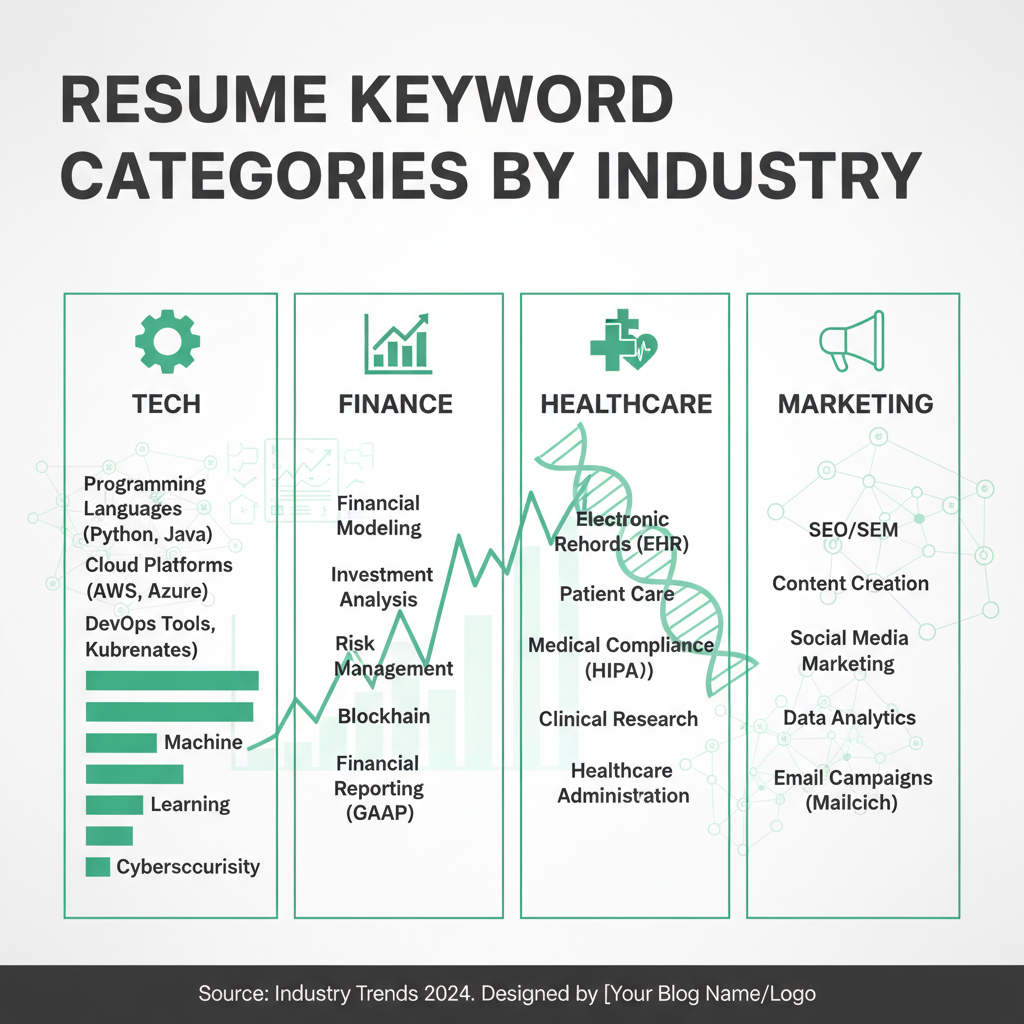
Technology & Software Engineering
Tech is the most ATS-heavy industry. Over 95% of tech companies use applicant tracking systems, and they parse aggressively for specific tools and methodologies.
High-Impact Keywords by Role
Software Engineers / Developers:
| Category | Keywords That Get Interviews |
|---|---|
| Languages | Python, Java, JavaScript, TypeScript, Go, Rust, C++, SQL |
| Frameworks | React, Next.js, Node.js, Spring Boot, Django, FastAPI, Angular |
| Cloud & DevOps | AWS, Azure, GCP, Docker, Kubernetes, Terraform, CI/CD, Jenkins, GitHub Actions |
| Practices | Agile, Scrum, microservices architecture, RESTful APIs, GraphQL, test-driven development |
| Data | PostgreSQL, MongoDB, Redis, Elasticsearch, Apache Kafka, data pipelines |
Product Managers:
| Category | Keywords That Get Interviews |
|---|---|
| Core Skills | product roadmap, user stories, A/B testing, product-market fit, stakeholder management |
| Methodologies | Agile, Scrum, Kanban, OKRs, sprint planning, backlog prioritization |
| Tools | Jira, Confluence, Figma, Amplitude, Mixpanel, SQL |
| Metrics | conversion rate, user retention, NPS, DAU/MAU, revenue growth, churn reduction |
Data Scientists / ML Engineers:
| Category | Keywords That Get Interviews |
|---|---|
| Technical | machine learning, deep learning, NLP, computer vision, large language models, RAG |
| Tools | TensorFlow, PyTorch, scikit-learn, pandas, NumPy, Jupyter, Spark |
| Cloud ML | SageMaker, Vertex AI, MLflow, model deployment, A/B testing |
| Methods | statistical modeling, hypothesis testing, feature engineering, model optimization |
Real Example: Before vs. After
Before (ATS Score: 38/100):
"Worked on backend systems and helped improve the codebase. Built features for the main application and collaborated with the team on various projects."
After (ATS Score: 91/100):
"Designed and deployed microservices architecture using Python and FastAPI, reducing API response times by 40%. Implemented CI/CD pipelines with GitHub Actions and Docker, enabling 3x faster deployment cycles. Collaborated with cross-functional teams using Agile methodology and Jira for sprint planning."
The difference? Exact technical keywords, quantified results, and industry-standard terminology.
Finance & Accounting
Financial services firms use ATS systems that scan for regulatory knowledge, specific certifications, and quantifiable impact. Vague language gets filtered immediately.
High-Impact Keywords by Role
Financial Analysts:
| Category | Keywords That Get Interviews |
|---|---|
| Core Skills | financial modeling, DCF analysis, valuation, due diligence, financial forecasting |
| Tools | Excel (advanced), Bloomberg Terminal, Capital IQ, Power BI, Tableau, SQL |
| Knowledge | GAAP, IFRS, SEC filings, 10-K analysis, risk assessment, portfolio management |
| Impact Words | revenue growth, cost reduction, ROI analysis, margin improvement, budget optimization |
Accountants / CPAs:
| Category | Keywords That Get Interviews |
|---|---|
| Core Skills | month-end close, reconciliation, accounts payable, accounts receivable, general ledger |
| Compliance | GAAP compliance, SOX compliance, internal controls, audit preparation, tax planning |
| Tools | QuickBooks, SAP, Oracle Financials, NetSuite, Workday, Excel (pivot tables, VLOOKUP) |
| Certifications | CPA, CMA, CFA, EA (include exact acronyms—ATS searches for both) |
Investment Banking / Private Equity:
| Category | Keywords That Get Interviews |
|---|---|
| Deal Skills | M&A, leveraged buyout, IPO, capital markets, deal sourcing, financial due diligence |
| Modeling | LBO model, three-statement model, comparable company analysis, precedent transactions |
| Tools | Bloomberg, PitchBook, FactSet, Capital IQ |
Keyword Placement Example
Professional Summary (finance):
"CPA-certified Financial Analyst with 6+ years of experience in financial modeling, DCF analysis, and portfolio management. Skilled in GAAP compliance and SEC reporting with a track record of delivering $2.4M in annual cost reduction through budget optimization and process improvement."
Notice: 8 keywords in 2 sentences. Natural reading. No stuffing.
Healthcare & Medical
Healthcare ATS systems are particularly strict because they filter for licensing, certifications, and compliance terminology. Missing a single credential keyword can mean automatic rejection.
High-Impact Keywords by Role
Registered Nurses:
| Category | Keywords That Get Interviews |
|---|---|
| Clinical | patient assessment, care planning, medication administration, IV therapy, wound care |
| Compliance | HIPAA compliance, infection control, patient safety, quality assurance, Joint Commission |
| Specialties | ICU, ER, OR, telemetry, pediatrics, oncology, med-surg (use exact unit names) |
| Certifications | RN, BSN, BLS, ACLS, PALS, CCRN (always include abbreviations AND full names) |
| Systems | Epic, Cerner, Meditech, electronic health records, patient documentation |
Healthcare Administration:
| Category | Keywords That Get Interviews |
|---|---|
| Operations | revenue cycle management, patient scheduling, claims processing, denial management |
| Compliance | HIPAA, CMS regulations, Medicare/Medicaid, Joint Commission accreditation |
| Leadership | staff management, budget oversight, process improvement, patient satisfaction scores |
| Tools | Epic, Cerner, Athenahealth, Workday, Tableau |
Pharmacists:
| Category | Keywords That Get Interviews |
|---|---|
| Clinical | medication therapy management, drug utilization review, formulary management |
| Compliance | FDA regulations, DEA compliance, controlled substance management |
| Skills | patient counseling, immunization administration, clinical pharmacy |
Critical Healthcare Tip
Always include both the abbreviation and full term for certifications and systems. Some ATS systems search for "ACLS" while others search for "Advanced Cardiovascular Life Support." Cover both:
"Certifications: BLS (Basic Life Support), ACLS (Advanced Cardiovascular Life Support), PALS (Pediatric Advanced Life Support)"
Marketing & Digital Marketing
Marketing roles have exploded in keyword complexity. Hiring managers now expect fluency across analytics, content, paid media, and automation platforms.
High-Impact Keywords by Role
Digital Marketing Managers:
| Category | Keywords That Get Interviews |
|---|---|
| Strategy | digital marketing strategy, lead generation, conversion rate optimization, customer acquisition |
| Paid Media | Google Ads, Meta Ads, PPC, programmatic advertising, ROAS, CPA, display advertising |
| SEO/Content | SEO strategy, content marketing, keyword research, link building, organic traffic growth |
| Analytics | Google Analytics 4, Google Tag Manager, attribution modeling, A/B testing, marketing ROI |
| Automation | HubSpot, Marketo, Salesforce Marketing Cloud, email automation, marketing workflows |
Content Marketing / Copywriting:
| Category | Keywords That Get Interviews |
|---|---|
| Skills | content strategy, editorial calendar, brand voice, copywriting, storytelling, content audit |
| SEO | on-page SEO, keyword research, meta descriptions, content optimization, SERP analysis |
| Distribution | social media marketing, email marketing, content syndication, influencer partnerships |
| Metrics | organic traffic, engagement rate, bounce rate, time on page, conversion rate |
Social Media Managers:
| Category | Keywords That Get Interviews |
|---|---|
| Platforms | Instagram, TikTok, LinkedIn, X (Twitter), Facebook, YouTube, Pinterest |
| Skills | community management, social media strategy, influencer marketing, paid social |
| Tools | Hootsuite, Sprout Social, Buffer, Later, Canva, CapCut |
| Metrics | engagement rate, follower growth, reach, impressions, social ROI |
The Marketing Keyword Trap
Marketing candidates commonly make this mistake: using creative language instead of searchable terms.
- "Drove brand awareness through innovative campaigns" → ATS finds: nothing useful
- "Increased organic traffic 150% through SEO strategy and content marketing, achieving $500K in lead generation" → ATS finds: organic traffic, SEO strategy, content marketing, lead generation
Save the creative language for your portfolio. Your resume needs to speak ATS first, human second.
Sales & Business Development
Sales roles are heavily metrics-driven. ATS systems for sales positions weight quantifiable achievements and CRM experience more than almost any other industry.
High-Impact Keywords
| Category | Keywords That Get Interviews |
|---|---|
| Core Skills | business development, account management, pipeline management, lead qualification, consultative selling |
| Methodologies | MEDDIC, SPIN selling, Challenger Sale, solution selling, value-based selling |
| CRM & Tools | Salesforce, HubSpot CRM, LinkedIn Sales Navigator, Outreach, Gong, ZoomInfo |
| Metrics | quota attainment, revenue growth, deal size, win rate, customer retention, ARR, MRR |
| Process | prospecting, cold outreach, contract negotiation, closing, cross-selling, upselling |
The Numbers Rule for Sales Resumes
In sales, every bullet point should contain a number. ATS systems for sales roles are often configured to flag resumes without quantified achievements:
Weak: "Managed key accounts and exceeded sales targets"
Strong: "Managed portfolio of 45 enterprise accounts ($12M ARR), achieving 127% quota attainment and 94% customer retention rate through consultative selling and quarterly business reviews"
Human Resources
HR professionals face an ironic challenge: they often manage the ATS but struggle to optimize their own resumes for it.
High-Impact Keywords
| Category | Keywords That Get Interviews |
|---|---|
| Core | talent acquisition, employee engagement, performance management, succession planning |
| Compliance | FMLA, ADA, EEO, FLSA, I-9 compliance, workplace investigations, labor relations |
| Tech | Workday, BambooHR, ADP, Greenhouse, Lever, HRIS, applicant tracking system |
| Strategy | workforce planning, employer branding, diversity and inclusion, organizational development |
| Compensation | total rewards, compensation analysis, benefits administration, salary benchmarking |
Universal Power Keywords That Work Across Industries
Regardless of your field, certain action-oriented keywords consistently score well in ATS systems. These are the verbs and phrases that signal impact:
Achievement Keywords
- Achieved, delivered, exceeded, surpassed, outperformed
- Increased revenue, reduced costs, improved efficiency
- Generated, launched, implemented, established, pioneered
Leadership Keywords
- Led, managed, directed, supervised, mentored, coached
- Cross-functional collaboration, stakeholder management
- Strategic planning, change management, team building
Process Keywords
- Streamlined, optimized, automated, standardized, consolidated
- Process improvement, workflow optimization, operational efficiency
- Quality assurance, continuous improvement, best practices
Quantification Patterns
ATS systems are increasingly configured to identify quantified achievements. Use these patterns:
- "Increased [metric] by [X]% in [timeframe]"
- "Managed [X] [things] resulting in [outcome]"
- "Reduced [metric] from [X] to [Y], saving $[amount]"
- "Led team of [X] to deliver [outcome] [X]% ahead of schedule"
The Keyword Strategy That Gets 90+ ATS Scores
Having the right keywords is only half the battle. Here's the exact placement strategy that Resume Lift uses to consistently achieve 90+ ATS scores:
Step 1: Extract Keywords from the Job Description
Don't guess. Pull keywords directly from the posting. For a typical job description, you'll find:
- 5-8 hard skills (tools, technologies, certifications)
- 3-5 soft skills (leadership, communication, collaboration)
- 2-4 industry terms (compliance frameworks, methodologies)
- 1-3 experience qualifiers (years, management level, industry)
Step 2: Prioritize by Frequency
If a keyword appears 3+ times in a job description, it's critical. If it appears once, it's nice-to-have. Focus your resume real estate on the most-mentioned terms.
Step 3: Distribute Across Sections
Here's the distribution formula that hits 2-3% density naturally:
- Professional Summary: Include top 3-4 keywords
- Skills Section: List all hard skills as exact keyword matches
- Work Experience: Weave remaining keywords into achievement bullets
- Education/Certifications: Include relevant credential keywords
Step 4: Customize for Every Application
This is where most people fail. A single resume cannot be optimized for multiple jobs. Each job description contains different keywords, different priorities, and different terminology.
This is exactly why Resume Lift was built. Paste a job description, and the AI extracts the exact keywords, checks them against your resume, and optimizes placement and density automatically—in under 5 minutes.
Common Keyword Mistakes That Tank Your ATS Score
Mistake 1: Using Synonyms Instead of Exact Terms
Job description says "project management" → You write "overseeing projects"
ATS result: 0 keyword matches for "project management"
Fix: Always use the exact phrase from the job description.
Mistake 2: Keyword Stuffing in One Section
Cramming all keywords into your skills section looks suspicious to both ATS and human reviewers. Some advanced ATS systems penalize obvious stuffing.
Fix: Distribute keywords across all resume sections following the 2-3% density rule.
Mistake 3: Ignoring Soft Skills Keywords
Many candidates focus exclusively on hard skills. But ATS systems also scan for soft skills mentioned in job descriptions: "cross-functional collaboration," "stakeholder management," "team leadership."
Fix: Include soft skill keywords in your summary and experience bullets, not just your skills list.
Mistake 4: Using Outdated Terminology
Industries evolve. "Big data" was hot in 2018. In 2026, the keywords are "data engineering," "ML pipelines," and "LLM fine-tuning." Similarly, "social media marketing" is now often "performance marketing" or "growth marketing."
Fix: Pull keywords from current job postings, not from guides published years ago.
Mistake 5: One Resume for All Applications
The #1 mistake we see across all 10,000+ optimizations on Resume Lift: submitting the same resume everywhere.
A product manager role at Stripe and a product manager role at a hospital will share maybe 40% of keywords. The other 60% is completely different. One resume cannot score well for both.
Fix: Customize for each application. With Resume Lift, this takes 5 minutes per job.
How Resume Lift Automates Keyword Optimization
Manual keyword research and placement is tedious and error-prone. Here's what happens when you use Resume Lift instead:
- Upload your resume — AI parses your existing content into structured sections
- Paste the job description — Claude Sonnet 4.5 extracts every relevant keyword and phrase
- Gap analysis — See exactly which keywords you're missing and which you already have
- Auto-optimization — AI rewrites your bullets to naturally integrate missing keywords at 2-3% density
- ATS score — Get an instant score showing how well you match the specific job
- Download & apply — Export your optimized resume in ATS-friendly PDF format
The average Resume Lift user sees their ATS score jump from 52 to 95 in their first optimization session.
Start Getting Your Keywords Right
The days of "spray and pray" job applications are over. In 2026, the candidates who get interviews are the ones whose resumes speak the exact language of ATS systems—with the right keywords, in the right places, at the right density.
You now have industry-specific keyword lists, placement strategies, and the density formula that works. The question is: will you spend hours doing this manually for every application, or let AI handle it in 5 minutes?
Resume Lift analyzes any job description and optimizes your resume keywords automatically. No guessing. No generic lists. Just exact-match keywords placed strategically for maximum ATS scores.
Frequently Asked Questions
How many keywords should I include in my resume?
For a standard one-page resume (~500 words), aim for 15-20 unique keywords from the job description. Your primary keywords (the most important 3-5) should appear 2-3 times each across different sections. Secondary keywords can appear once. Total keyword density should stay between 2-3%.
Should I include keywords I only partially match?
Yes—if you have related experience. If a job requires "Kubernetes" and you've used Docker extensively, include both: "Docker containerization with exposure to Kubernetes orchestration." This shows progression without misrepresenting your skills.
Do ATS systems read cover letters for keywords?
Some do, most don't. Only about 35% of ATS systems parse cover letters for keywords. Focus your optimization energy on the resume itself. If you do write a cover letter, naturally include 3-5 top keywords as reinforcement.
How often do I need to update my keyword list?
Review quarterly at minimum. Technology keywords shift fastest (new frameworks, tools, and methodologies emerge constantly). Soft skills and management keywords remain more stable. Always pull fresh keywords from current job postings rather than relying on saved lists.
What's the difference between hard skills and soft skills keywords for ATS?
Hard skills (Python, Salesforce, GAAP compliance) are typically weighted higher and searched as exact matches. Soft skills (leadership, communication, problem-solving) are searched but weighted lower. Both matter—a resume missing all soft skills keywords will score lower, even with perfect hard skill matches.
Last Updated: February 20, 2026
About the Author: This guide was researched and written by the Resume Lift team, combining data from 10,000+ resume optimizations with insights from recruiters and hiring managers across 8 major industries.
Ready to Optimize Your Resume?
Start using AI-powered resume optimization to land more interviews and get past ATS systems.
Get Started Free